


-
-
Our Advice
- Our catalogues
Between air-to-water (aerothermal) and water-to-water (geothermal) heat pumps—whether reversible or not—and considerations regarding power, sizing, and performance; how do you make sense of it all and choose the right unit? It’s helpful to have a basic understanding of the key criteria before consulting a professional for guidance.
Between air-to-water (aerothermal) and water-to-water (geothermal) heat pumps—whether reversible or not—and considerations regarding power, sizing, and performance; how do you make sense of it all and choose the right unit? It’s helpful to have a basic understanding of the key criteria before consulting a professional for guidance. A professional is best placed to identify the right heat pump for your needs and install it according to industry standards. Let’s take a quick look at the essentials you need to know.
· Consider the property type: newly built vs. renovation, insulation levels, and existing equipment (e.g., presence or absence of a hot water circulation loop).
· Define your needs: heating only, domestic hot water, cooling, etc., and whether you require connectivity to manage your comfort remotely.
· Take existing conditions into account: unit placement (especially the outdoor unit), existing heat emitters (radiators, underfloor heating, etc.), and various space constraints.
· Ensure proper sizing and performance assessment: appropriate power output, high efficiency (COP), and a clear overall budget (purchase + installation + financial incentives) are essential.
Before choosing a heat pump, it is worth taking a quick look at the different types available.
There are two main categories of heat pumps designed for homes with hot-water heating systems:
· Air-to-water heat pump: This is the most common type. It captures heat naturally present in the air and transfers it to the water in the heating system.
· Water-to-water heat pump: This type extracts heat from the ground and transfers it to the heating system.
Air-to-water heat pumps are the most popular choice among consumers. This is partly because they are easier to install and well-suited for retrofitting existing homes, and partly because they have a lower initial purchase price, as the installation work is less complex. They account for over 90% of the market. Read on to learn how to choose the right air-to-water heat pump!
Water-to-water heat pumps, on the other hand, require extensive drilling and excavation work outside the home, as the thermal collector system must be installed underground. Consequently, this solution is better suited for new builds. However, please note that this type of heat pump requires specific permits, meaning it cannot be installed just anywhere.
The major advantage of the air-to-water heat pump is, of course, the energy savings it offers: up to 60%! By eliminating reliance on fossil fuels such as gas or heating oil—which are subject to significant price fluctuations—and using air as its primary energy source, the heat pump is more economical to operate.
Before diving headfirst into heat pump comparisons, the first step is to ask yourself the right questions.
First of all, what type of home are you outfitting? Is it a new, well-insulated property, or are you replacing the boiler in your current home? Good insulation is essential before installing a new heating system. In a newly built home, this shouldn't be an issue. However, in a poorly insulated home, you risk wasting a great deal of energy on heating—even if your unit is brand new and highly efficient!
The choice will differ for a house in the country undergoing renovation. Be sure to check that the heat pump you are considering is compatible with your existing heating system.
Some models allow you to keep your high-temperature radiators (or cast-iron radiators), which is preferable and easier to install.
It is easy to determine where the heat pump’s indoor unit will go, since in most cases—especially when replacing an old system—it is installed in the same spot as the previous boiler. However, people often give less thought to the outdoor unit, which must meet certain basic criteria—particularly regarding distance from neighbors—to minimize noise disturbance. For a split-system air-to-water heat pump (consisting of both an outdoor and an indoor unit), the outdoor component is placed in your garden. If your garden is at least 200 m² and you can position the unit well away from your neighbors' windows—as well as your own bedroom windows—then it is an ideal setup!
Your choice of heat pump will therefore be influenced by the outdoor space available at your home—whether a garden or a courtyard—for the installation of the outdoor unit.
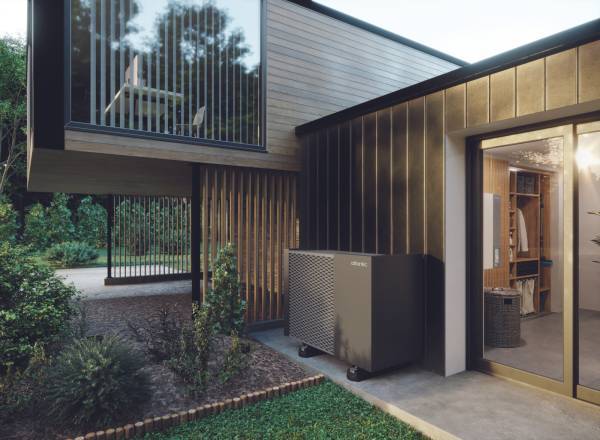
An air-to-water heat pump consists of an indoor unit and an outdoor unit that need to be positioned correctly (Ixtra M model).
Next among the factors to consider are your specific needs: will the heat pump be used solely for home heating? Do you want a reversible model that can also cool the indoor air during summer? There are also heat pumps capable of producing domestic hot water—another factor to include in your decision-making! And why not consider a smart heat pump that allows for remote control?
There is no need to worry if outdoor temperatures drop significantly in winter. Heat pumps equipped with an electric backup system continue to provide the necessary heat to maintain ideal indoor comfort. All air-to-water heat pump models (with the exception of hybrid models, though these offer other advantages) feature an electric backup.
Connectivity is all about your comfort, too!
With the Atlantic Cozytouch solution, you can control your heat pump from anywhere, at any time. Need to turn the heating up or down? Stop hot water production? It’s all possible with a connected heat pump… To find out more about connected heat pumps, click here.
This is the most common type of air-to-water heat pump. It serves as a complete replacement for an old gas or oil boiler and heats the home just as effectively. The indoor unit of a heating-only heat pump is quite compact, taking up about the same amount of space as a wall-mounted boiler. If you already have a separate water heater for your hot water needs, that will suffice. However, if you want the heat pump to also provide domestic hot water, opt for a "Duo" model.
All air-to-water heat pump models in the Atlantic range are available in a "Duo" version, meaning they can handle both space heating and domestic hot water production. This type of heat pump is known as a "dual-service" model because it manages two functions. Duo models feature an indoor unit that is larger than that of single-service models (taking up roughly the same space as a large refrigerator) because it houses a domestic hot water storage tank.
In addition to heating, air-to-water heat pumps can also provide cooling! By reversing the heat pump cycle, the unit circulates cool water through the system instead of hot water. This cooling function can lower the indoor temperature by up to 6°C—a welcome relief during hot weather. All Atlantic air-to-water heat pump models can provide cooling (available as an option via a kit requested from your installer). However, this requires the right heat emitters: hydronic underfloor or ceiling heating/cooling systems, or fan coils (also known as dynamic or reversible radiators). The air-to-water heat pump can thus serve as a 3-in-1 unit!
Finally, there are the heat emitters—the components at the heart of your home that directly determine your thermal comfort. Which heat emitters will be connected to the heat pump? Do you have high-temperature radiators? Is your home equipped with underfloor heating? Or would you prefer to install fan coils? Depending on the type of emitters installed, some heat pumps are more suitable than others.
High-temperature radiators: If you are installing a heat pump to replace a boiler, ensure the chosen model is compatible with your existing radiators. This will simplify the energy renovation process.
Underfloor heating: If you are building a new home, the ideal solution is to install a heating and cooling floor system that can also provide cooling in the summer when paired with a reversible heat pump. All Atlantic heat pump models are compatible with this type of emitter!
Fan coils: A hybrid between fans and radiators, fan coil units offer consistent thermal comfort and respond quickly to temperature changes. They are compatible with air-to-water or water-to-water heat pumps.
The power output of your heat pump varies depending on the functions selected and the amount of heat required. A heat pump's heating capacity is measured by its thermal output, expressed in kilowatts (kW). Naturally, only a professional is qualified to determine the appropriate power rating for your specific needs, so do not hesitate to contact a local installer.
Higher power doesn’t necessarily mean greater efficiency... That is precisely why it is essential to call in a professional installer to find the heat pump best suited to your needs.
If your heat pump is too powerful—a situation known as oversizing—it results in higher purchase costs, an increased number of operating cycles, and consequently, higher electricity consumption and faster wear and tear.
Conversely, if your heat pump lacks sufficient power—known as undersizing—it will fail to meet all your heating needs, meaning thermal comfort in your home cannot be guaranteed.
Remember: a properly executed installation means guaranteed savings!
A heat pump's capacity determines its Coefficient of Performance, or COP. This indicator measures the unit's efficiency. Although it is a small figure, checking it is essential when selecting a heat pump, as it reveals the amount of heat produced relative to the amount of electricity consumed. The higher the COP, the more efficient the heat pump. A high-performance heat pump will have a COP greater than 3. In practical terms, this means that for every 1 kWh (kilowatt-hour) of electricity consumed, the heat pump generates at least 3 kWh of heat. The unit therefore produces three times as much energy as it consumes—leading to significant energy savings.
The coefficient of performance (or COP) of a heat pump is higher when the temperature difference between the external source and the heat emitters is smaller—which makes sense! If the unit does not need to heat the distribution system as much, it will consume less energy. Consequently, it is more cost-effective to use low-temperature emitters, such as underfloor heating or fan coils.
Now is the time to assess your budget for purchasing and installing a heat pump. In addition to the selection criteria discussed here, the budget you can allocate to this new equipment is obviously a crucial factor.
For instance, if you decide to opt for an air-to-water heat pump, your budget must cover:
· The cost of the heat pump
· Its installation
· Financial aid/incentives
To accelerate energy-efficiency renovations and encourage the replacement of energy-intensive appliances, various financial incentives are available, subject to certain conditions. The only mandatory requirement is that the work be carried out by an RGE-certified professional (Recognized Guarantor of the Environment).
Available in heating-only or domestic hot water versions and in various power outputs, it features a patented coaxial heat exchanger that ensures durability; it is connected, maintains temperature without electric backup down to -20°C, and has an indoor unit manufactured in France. Meet the Alfea Excellia A.I.: an air-to-water heat pump designed specifically for renovation projects—the ideal replacement for a gas or oil boiler.
Finally, keep in mind that installing a heat pump to replace an oil-fired boiler, for example, means choosing cost savings and renewable energy, as well as improving your home's energy performance rating (DPE).
A writer with nearly 15 years of experience, I am responsible for making Atlantic’s solutions easy to understand, specializing in radiators, towel warmers, water heaters, boilers, and air-to-water and hybrid heat pumps. My goal is to give homeowners the information they need to understand our products and embark on their renovation projects with confidence.
On a personal note, I am passionate about travel, interested in the beauty and wellness sector, and an avid reader.